The Courage Deficit

“Incontestably, alas, most people are not, in action, worth very much; and yet, every human being is an unprecedented miracle. One tries to treat them as the miracles they are, while trying to protect oneself against the disasters they’ve become.”
― James Baldwin, No Name in the Street
On a hot, humid monsoon afternoon in a rural village in Uttar Pradesh, India, 28-year-old Nikki Bhati was embroiled in another fight with her husband, Vipin. The household—Nikki’s in-laws, her sister Kanchan (married to Vipin’s brother), and her seven-year-old son, watched as things began to reel out of control. Outraged that Nikki continued to run a beauty salon with Kanchan in spite of numerous threats and physical abuse, Vipin and his mother, Daya, had had enough. Vipin dragged her by the hair, forced her to the floor, beat her, and doused her with paint thinner. Then Vipin set her ablaze with a lighter handed to him crisply by Daya standing over her. Nikki’s son watched in horror, screaming for someone to help her.
Six months earlier, in February 2025, Nikki had fled to her parents’ house. For close to ten years, Nikki was subject to her husband’s torture and violence. But the parents downplayed her pleas for help even though the in-laws persisted in unreasonable dowry demands of money and expensive cars, signaling Nikki’s life was in danger. Despite being outlawed 60 years ago, dowry remains deeply entrenched in India’s patriarchal society, fueling violence that kills around 20 women every day. Instead of going to the police, her parents accepted a limp apology from Vipin, returning Nikki to live again in her in-laws home with Vipin.
Dowry, in its simplest terms, is money, property, or valuable security given by the bride’s family to the groom before or at the time of marriage or even after it. In modern parlance, these exchanges are conveniently referred to as “gifts,” totally ignoring the fact that the dowry is given under compulsion and in the absence of which there will be no marriage transacted, or worse. The bride, then, becomes a problem—one that can be solved by some kind of “accident” so that the groom or husband may go on to marry another, better-endowed wife. Police investigations into Nikki’s death reveal that the event was, in fact, meticulously conspired by the in-laws. The charge sheet named Vipin, Daya, father-in-law Satyaveer, and brother-in-law Rohit as co-conspirators.
As the saying goes, it takes a village to raise a child. Similarly, it takes a village to create and perpetuate evil. The wife-killing, dowry-burning, and so-called “honor killing” culture that persists in India only persists because a larger system is complicit. Even though Vipin did the actual killing, and Daya, Satyaveer, and Rohit were the supporting acts, an entire ecosystem of secrecy and enabling allowed this horror to occur.
The question, then, is how entire communities become participants in harm. Harm rarely happens in isolation. Around every act of violence or corruption, there are layers of participation—those who plan it, those who enable it, and those who quietly look away. This is how evil can perpetuate for decades, even centuries, in plain sight.
Journalist and author Anand Giridharadas has spent his career investigating and writing about the intersection of wealth, power, and inequality. He coined the concept of "concentric circles of enablement" to explain how several successive layers of complicity within society help support and perpetuate the inner dark heart of wrongdoing.
In the case of Nikki’s murder, there is no doubt that in the beating dark heart of the event, there is a husband who lights the blaze, but around him are family, friends, a lover, and an entire village who keep his secrets.
While this example is extreme, it’s useful to illustrate an often-hidden yet fundamental dynamic that needs to be called out. In the context of violence, corruption or even just garden-variety perpetration, it is convenient to think that it is just “one evil sociopath” or “one bad apple” or “it’s the uber-wealthy elite,” so we don’t have to look at ourselves, our community, our society, and the ways we play a role.
Adapting Giridharadas’s idea, I think of it as three broad zones of enablement, illustrating the various positions people might take in a given situation.
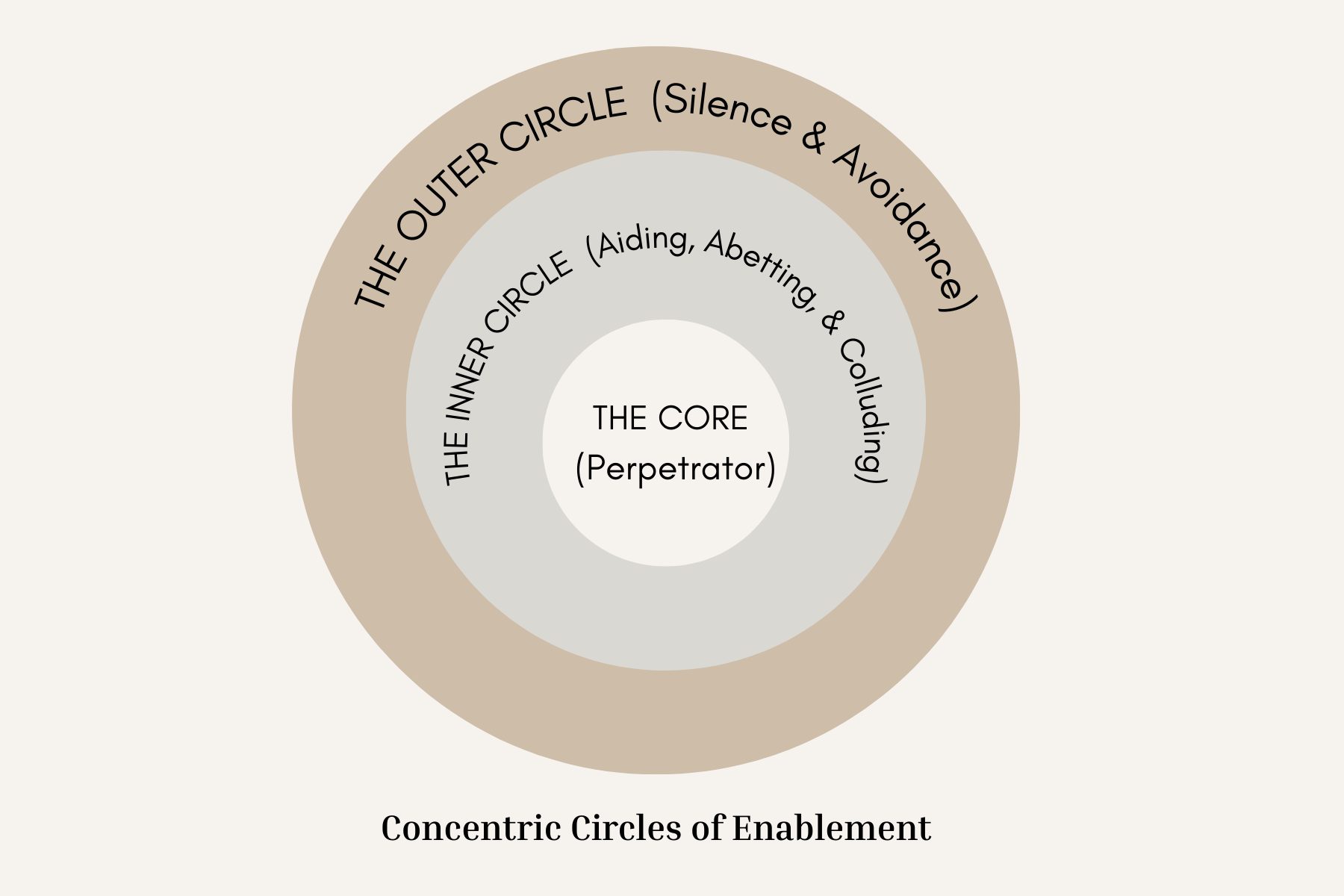
Let’s walk through it:
The Core: the perpetrator – this is the one(s) who does the deed and has the most to gain and profit from the deed.
The Inner Circle: aiding, abetting, and colluding – these are the ones to help the perpetrator(s) do the deed by providing financial support, supplies, assisting in planning, advice, and preparation, but are not necessarily on the scene. They will benefit somewhat by the deed either through money, privilege, proximity, and/or power.
The Outer Circle: silence and avoidance – the people who know about the deed, or have heard about the deed but say nothing, and do not go to the authorities, or take any other action to prevent or report it. Also, those who choose not to know, to look away, bury their heads in the sand, minimize, and generally ignore the issue to the point that there is little to no awareness of it.
As you can see, many rings of enablement surround the heart of a crime or toxic situation. But it’s the Outer Circle of enablement that allows perpetration to operate in plain sight.
Take the astonishing recent case of Gisèle Pelicot, the French housewife who survived mass raping organized by her husband. For over a decade, Dominique Pelicot drugged Gisèle and recruited over 70 men from the local community to come over to his home and have their way with his wife’s comatose body. They were butchers, bakers, and candlestick-makers. They were firefighters, electricians, and supermarket employees. They were “good dads,” “good husbands,” and “fine upstanding average middle-class citizens.” How on earth, we ask, could such a thing continue to happen over so many years, involving so many people? The answer: the Outer Circle of enablement.
For the over 70 men who conspired to do the crime (51 were convicted), there were dozens more who knew about it but chose to say and do nothing. There were others who suspected something was wrong and chose not to intervene.
But I digress into severe examples. Let’s explore more mundane ways in which the Concentric Circles of Enablement exist yet can still erode the quality of our lives.
I live in a small valley tucked between the foothills that skirt the National Forest. A string of homes lines an arroyo (dry watercourse) that winds its way into the mountains. I ride and hike almost daily along the arroyo, as it gives access to miles of trails. The neighbors have grown to appreciate that I can spot and report any unusual activity that can be addressed immediately, as it takes easily 30 – 50 minutes to hail a sheriff. Lost dogs are found, illegal traps disengaged, or a would-be thief diverted.
A few weeks ago, I spotted some ATV tracks running along the arroyo, through everyone’s properties, and into the National Forest. Motorized vehicles are prohibited in these areas, especially in the fragile riparian areas of an arroyo. I notified the community, and we began to coordinate efforts to report the ATV. That is, until we discovered that the ATV was owned by a neighbor who had just moved here from a big city.
That’s when everything got interesting. Suddenly, no one wanted to do anything, and people scattered to their various places in the Concentric Circles of Enablement. Many chose to stay silent, some diverted their attention immediately, and refused to acknowledge that the situation was problematic. Only two of us were willing to either write a letter or speak with the neighbor. And as others retreated into silence, even our own courage began to waver.
In the end, I had the conversation with the neighbor. No more ATVs driving in our peaceful valley. But had I not been willing to speak up, the situation would likely have gotten worse. Tracks have a way of attracting more tracks, and even more ATVs.
It was interesting to experience the pushback from some of the neighbors who were retreating into complicity and trying to manipulate me into silence, “You are just causing a drama”, “It’s not your business”, “Oh, it’s probably just this one time”, “Are you absolutely sure it’s him?” and my favorite, “I don’t see any tracks”.
I became curious as to what made the neighborhood turn from “let’s do something about it” to “let’s forget about it”. The turn happened as soon as the stakes emerged. When the ATV driver was revealed to be not a stranger, but our neighbor, the desire to be liked, to be seen as a good neighbor, not to get into a fight with a neighbor, and the like, began to emerge. To me, this dynamic illustrates a curious aspect of our human nature, and one that we see playing out now on the national and international stage, but with much higher stakes—freedom.
“It seems to me that we can’t get better, we can’t become the kinds of people that democracies require if we keep lying to ourselves about who we are. And I think being honest that decency is not the defining attribute of the American public—it’s something we aspire to be. But as human beings we are fraught and fallen,” said Dr. Eddie Glaude Jr., the renowned Princeton historian of race and democracy in an interview recently. He went on to say that we as a people have a “deficit of courage”.
What’s happening in America, and at a smaller scale, any unsavory things happening in our communities, and our families, happen because of enablement. So, the question is, when the stakes start to rise, where do you land in the diagram? Are there circumstances where you tend to be more outspoken, and others where you retreat? When you retreat, what are your excuses? Do you claim that you are apolitical or assert that you don’t want to cause trouble? Or perhaps you don’t want to be seen as a Karen or a grouchy jerk? Perhaps you want there to be peace at the family dinner table. Maybe you don’t want to make a mistake or be seen as stupid. Whatever the case may be, these times urge us to explore that in ourselves. For we are in a time in human history where we can no longer just look away.
If the concentric circles of enablement can allow a murder in a village or a crime in a household, imagine what happens when those circles extend into institutions of immense power.
Artist and photographer Dana Spaeth captured the scale of enablement surrounding the Epstein network in this stark reflection:
Clinton knew, Bush knew, Obama knew, Trump knew, Biden knew, they knew it was bigger than Epstein. They knew it was a network; they knew girls were being raped, and the Attorney General knew too. Janet Reno knew, John Ashcroft knew, Alberto Gonzales knew, Michael Mukasey knew, Eric Holder knew, Loretta Lynch knew, Geoff Sessions knew, William Barr knew, Merrick Garland knew, and the FBI knew. Louise Free knew, Robert Mueller knew, James Comey knew, Andrew McCabe knew, Christopher Wray knew. US Attorneys knew, Assistant US Attorneys knew, federal, state and county prosecutors knew, supervisors knew, investigators knew, agents in multiple FBI field offices knew. The people who signed off on warrants knew, the people who buried leads knew. The people who negotiated plea deals knew, the people who drafted the paperwork knew, judges knew, defense attorneys knew, police chiefs knew, sheriffs knew, detectives knew, intelligence analysts knew. Doctors knew, nurses knew, therapists knew, drivers knew, pilots knew, security knew, accountants knew, bankers knew, lawyers handling NDA‘s and settlements knew, maids, butlers, and caterers knew, so many of the people who knew are mothers and fathers…Mothers and fathers knew.
How do our little private interpersonal opportunities to speak up have anything to do with saving democracy? Our everyday garden-variety silences become part of a pattern woven into the fabric of a collective dynamic that remains silent. And conversely, the larger cultural dynamic informs and shapes our private lives. When silence and looking away become collectively normalized, it’s easier to ignore the bruises on our daughter’s arms, or the dog next door freezing to death in the cold.
It’s not enough to rely on our leaders to speak truth to power, or rely on the brave, outspoken few; we each need to enact it in our daily lives. You have to turn to the people next to you, around your dinner table, at the kitchen counter, at your church, and say, “No, the thing you just said is not ok”, “No, we are not going to just laugh this off”, “Yes, we are going to talk about this”.
“I’m not fun at parties anymore, I admit it.” said The Atlantic’s Tom Nichols as he spoke about standing up for human decency and saving democracy, “I turn to people I know and say, ‘this is wrong; what you are doing and saying is wrong, and you know in your heart it is wrong’”.
As “the big reveal” seems to be happening worldwide, revealing the dark underpinning of our collective nature, we can no longer conveniently imagine this as a small subset of humanity. As the lights come on, the only real question is this: Who will you choose to be when silence is no longer possible?
Kelly Wendorf is an ICF Master Certified executive and personal coach, published author, spiritual mentor, disruptor, and socially responsible entrepreneur. As founder of EQUUS® she specializes in the liberation of robust leadership capacities in those who are most qualified — the empathetic, the conscientious, the accountable, the generous, and the kind. Did you like this essay? Kelly is available for a wide range of services including Coaching, Workshops, The EQUUS Experience®, Retreats, Keynote Speaking and more. Kelly is the Author of Flying Lead Change: 56 Million Years of Wisdom for Living and Leading.