Deadfall
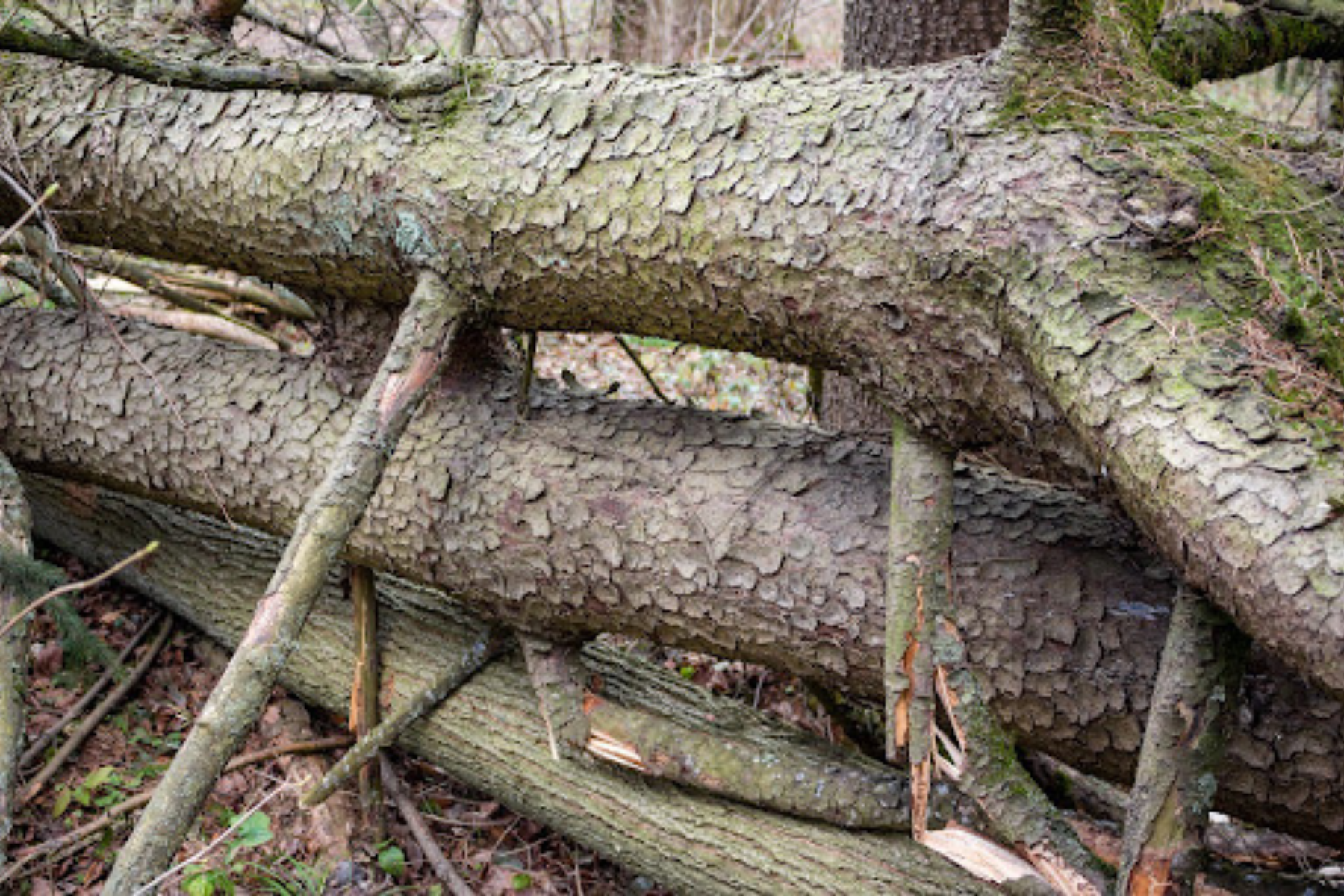
Holy shit!
I paused, out of breath, and looked across the expanse of fallen trees ahead. Maria and I were ten miles into a multi-day backpacking adventure in the Pecos Wilderness. The stretch of wooden cadavers before us was so dense the trail was no longer visible. All we could see was a grey wall of logs and large branches strewn across the landscape. It was as if the heavens had begun a game of Pick Up Sticks and gleefully commenced by hurling down a fistful of giant wooden skewers.
Game on.
We looked at each other. There was no turning back now. We had to land at basecamp by nightfall––a high alpine lake just below Pecos Baldy––for water and sleep. Despite our meticulous planning for weeks, we had not anticipated this. But climate change is most readily witnessed in the wild, and the savage bark beetle is just the latest crusader, leaving behind millions of acres of standing skeletons amidst the resilient pines—skeletons that soon fall like soldiers taking down many live ones with them, collateral damage of human recklessness.
Deadfall ˈded-ˌfȯl
1. a trap so constructed that a weight (such as a heavy log) falls on an animal and kills or disables it
2. a tangled mass of fallen trees and branches
The going was slow, tedious, and admittedly dangerous. Every few steps ahead brought another gnarled knot of timber, with sharp protruding daggers where branches had broken off. Sometimes we crawled commando-style under a canopy of wooden spears. Sometimes it meant carefully navigating over dead trees stacked one atop the other, climbing and straddling. One slip and we risked impaling ourselves. Alone in my thoughts, I was grateful we had a first aid kit that included a tourniquet, one I had just purchased the week before.
By the time we realized what we were in for, we had gone too far to turn back. And we had no idea how much more we had to take on, but we trusted our instincts to continue. We looked like mountain spiders, wending our way through the wreckage. What would have taken us an hour to hike through took us easily five. The ordeal was physical, to be sure, but it was mostly mental. Despair lurked closely nearby, and Maria and I had to work intensely to stay engaged and positive. One ominous tangle at a time.
The wilderness is full of metaphor, and deadfall is certainly a powerful one. Is it an obstacle to be conquered, or a growth opportunity? When the universe provides a disturbance, what does it really mean? Is it a sign to turn around? Is it a lesson to be learned (because—shame on you—you need a good hard lesson)? Is it because you are simply not good enough? Is it because you are not meant to be there?
Largely left to my own devices as a child growing up in Northern New Mexico, nature always presented a powerful curriculum. If I daydreamed while walking through sagebrush, a rattlesnake would snap me back into presence. If I forgot to care for my jar of tadpoles, their tragically shortened lives lived in my conscience. Ever the trustworthy teacher, nature shows us what’s really true. As an adult, I learned of a framework from nature that helps us understand cycles and seasons in our lives. The Adaptive Cycle is based on nature’s 3.8 billion years of evolutionary intelligence.
Essentially, this framework—unlike most frameworks that are based on concepts and theories invented by humans about humans—was “invented” by nature*. The Adaptive Cycle is a highly reliable blueprint for tracking how complex systems—from forests to economies—undergo evolutionary transformation. This also includes the complex system of your own life, your family, your organization, and your engagements.
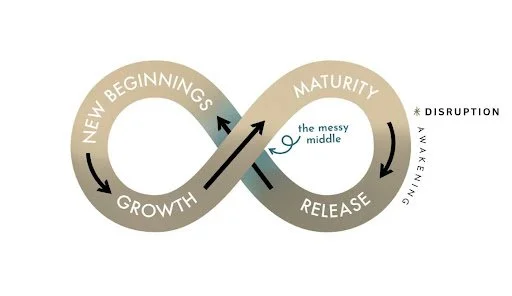
* As interpreted through ecologist Crawford (Buzz) Holling, who developed it to explain how complex systems evolve.
Disruption is that deadfall moment—when life says, “Whoops, not so fast there! Let’s see how you handle this!” while tossing down the ordeal in front of your feet. It’s the moment we want to freak out, catastrophize, pathologize, and pick up our ball and go home.
We all know those moments. You’re fired. Your spouse wants to leave the marriage. Perhaps it’s a scary diagnosis. An accident. Or a pandemic. Or maybe it’s something positive but still changes everything—a new baby (or a new puppy), a move to Europe, or finally leaving that toxic boss and starting your own business.
Regardless, “positive” or “negative”, from nature’s point of view, it is regenerative. Disruption is the catalyst for change. For larger systems, like a forest consumed by a forest fire, it’s the opportunity not only to repair, but evolve into a better, more robust version of itself. For you, disruption heralds your big chance to bounce forward into a new iteration of yourself.
Even in micro-adaptive phases, such as my recent backpacking trip, life’s momentum is towards growth. The person I was before encountering the deadfall was very different from the person who emerged on the other side. What was left behind in those tangled woods was a more naïve version of me, the one who entered the wild with a cavalier confidence whose hubris could be the end of her.
The key lies in how a person or a system (a team, family, or community) approaches disruption. Do you fight it, oppress it, and reject it? Or do you work with it? If you fight it, you place yourself at odds with natural forces that are perpetually driving evolution. This makes you, or the system you are working within, maladaptive. If you turn towards disruption and work with it, you or the system becomes adaptive.
Nature doesn’t care either way. What it does do, however, is drive and energize adaptive systems. Systems that are adaptive tend to be not only sustainable but also regenerative, resilient, and ever-evolving. Systems that are maladaptive have a short shelf life.
It’s understandable that we at first approach a disruption in our lives with suspicion and fear. Our minds do not like change. When Maria and I first happened upon the deadfall, our hearts sank. What the actual hell? In our dysregulated state, we may initially react maladaptively. We might feel undermined and victimized: “Why is the universe doing this to me?”
Over the decades of living inside the strict tutelage of the natural world, I’ve learned how to shift my tendency to feel victimized by life’s disruptive events by asking myself one simple question:
“What does the universe want for me?”
This question transforms the disruption from enemy to ally. This simple shift in perspective represents the possibility for a quantum leap. “Just think of how strong we are getting!” Maria said cheerfully as she scootched under a massive log on her elbows, barely clearing her backpack through the fallen branches. She wasn’t casting rainbows inappropriately; she was signaling a mindset.
Indigenous and shamanic cosmologies call this mindset or inner posture “taking responsibility”. Thunder Bear tells me that his people call it looking for life. “Yeah, it’s a way of being that is sacred,” he told me the other day as we were taking a horseback ride into the foothills. “It takes a perspective that is outside of ordinary human reality and instead observes it from a higher place.” He was quiet for a moment, as we paused to let our horses graze in a shady meadow, their contented munching filling the space between us. “It’s rare that people can do it. But if they do, they are blessed,” he finally continued.
Yes, the season after a disruption is messy and hard. As you see in the above model, after disruption comes the phase of collapse—endings and letting go. After that, nature is still not done with you. You encounter the liminal phase where nothing really makes sense anymore (think of the caterpillar, melted into goo in their chrysalis). I didn't know it then, but straddling that log four feet above the spikes, backpack heavy, water gone, annihilation eyeing me from the other side—I was becoming.
My time in the Pecos Wilderness tracked the Adaptive Cycle perfectly. We were humming along the trail nicely (the consolidation/conservation phase). Then, the deadfall appeared before us—our disruption. We didn’t conquer it with chainsaws or turn around and go home; we worked with it. We had to maintain an adaptive mindset in order not to collapse into despair and fear. In so doing, we had to let go of many things—our timeline, our trail, our plans, our sunny conversation. We were forced to be profoundly present. It was messy; we felt lost along the way.
In those moments, you have two choices: succumb, or keep going. We chose the latter. After some time, we finally emerged. I paused and looked back at the grey tangle of logs. It looked like a fairy-book version of an ominous, forbidden forest where children wandered and never came back. Maria and I looked at each other and grinned, followed by a hearty high-five. Our hearts felt bolder. I could feel myself step into a larger version of myself, more confident and grounded.
That evening, we made camp near the high-alpine lake, embraced by the surrounding peaks. Finally tucked into our sleeping bags, I lay listening to the crickets. The stars were obscene in their abundance. In that stillness, I felt it again—the thing the wild has always been trying to tell me: Do not be afraid of the shadow places. Crisis, setbacks, interruptions—these are not punishments, or tests, or even lessons. They are the terrain. Life wants something for you inside them.
Kelly Wendorf is an ICF Master Certified executive and personal coach, published author, spiritual mentor, disruptor, and socially responsible entrepreneur. As founder of EQUUS® she specializes in the liberation of robust leadership capacities in those who are most qualified — the empathetic, the conscientious, the accountable, the generous, and the kind. Did you like this essay? Kelly is available for a wide range of services including Coaching, Workshops, The EQUUS Experience®, Retreats, Keynote Speaking and more. Kelly is the Author of Flying Lead Change: 56 Million Years of Wisdom for Living and Leading.