May this essay find the person it’s meant for.
Amsterdam, 1996. I am sitting alone in a tiny, dark apartment on the floor, my baby son on the bed next to me. He’s finally fallen asleep. I shift my weight on the dirty carpet. No doubt it hasn’t been vacuumed in months. There’s a slight stench of bad marijuana mixed with stale trash. The guy who lent us his apartment was a bachelor and a follower of my then husband, Isaac, a self-anointed guru. Isaac hated spending money on accommodations for us as we traveled the world for his work, especially if he could bargain on his devotees' goodwill.
I am sad, and lonely, and more despairing than I’ve ever felt in my life. Isaac is out teaching, no doubt spending the remaining hours of the night in the arms of another starry-eyed sycophant. I place my hand softly on my baby’s back; his breaths are soft and deep. She’s probably German, I think to myself, and has just returned from India, all flowing and easy, beaming in the afterglow of enlightenment—bitch.
I let out a shaky exhale, scolding myself for being so triggered, and begin practicing what I have been taught by a patriarchal spiritual system—bypass the overwhelming feelings of rage, isolation, and betrayal; silence my pain, override any sense of dignity—and instead reach for something holy and pure. I close my eyes and grasp a mantra, a fingerhold on a sheer cliff face, as I strain to climb to higher ground.
Just then, the entire apartment darkens, and a chill fills the air. I tighten my shawl around my shoulders, shivering. An unmistakable presence enters the room. My mind tries wildly to make sense of what’s happening. I am sober. I’ve never had an experience like this and previously dismissed such accounts as fantasy. But nonetheless, She is here.
Describing this event is difficult, in part because it is articulated only by paradox: she is a she, but also no gender. She is in form, yet formless. She is frighteningly fierce, yet overwhelmingly loving.
I have no choice but to give over to what seems my lunatic break with reality: am I going mad? Are the walls of this shitty apartment giving off so many fumes that I am high and hallucinating? I look over at the dim form of my baby. He contentedly snuffles under the covers. I pull myself together and decide to engage.
She smiles warmly. “My name,” she says, “is Kali.” I had heard of the Hindu goddess and seen her ferocious depiction on temples in India. But I had been repelled by her gory portrayal —mouth agape revealing fangs, blood dripping down her chin, a necklace of skulls, wielding a jagged sword, bony, wild, and hostile. I preferred the dainty and beautiful devas (deities) — Lakshmi, Parvati, and the lovely Saraswati. Kali, well, she was just downright disgusting. But anyway, these were just characters in India’s own Marvel comics as far as I was concerned.
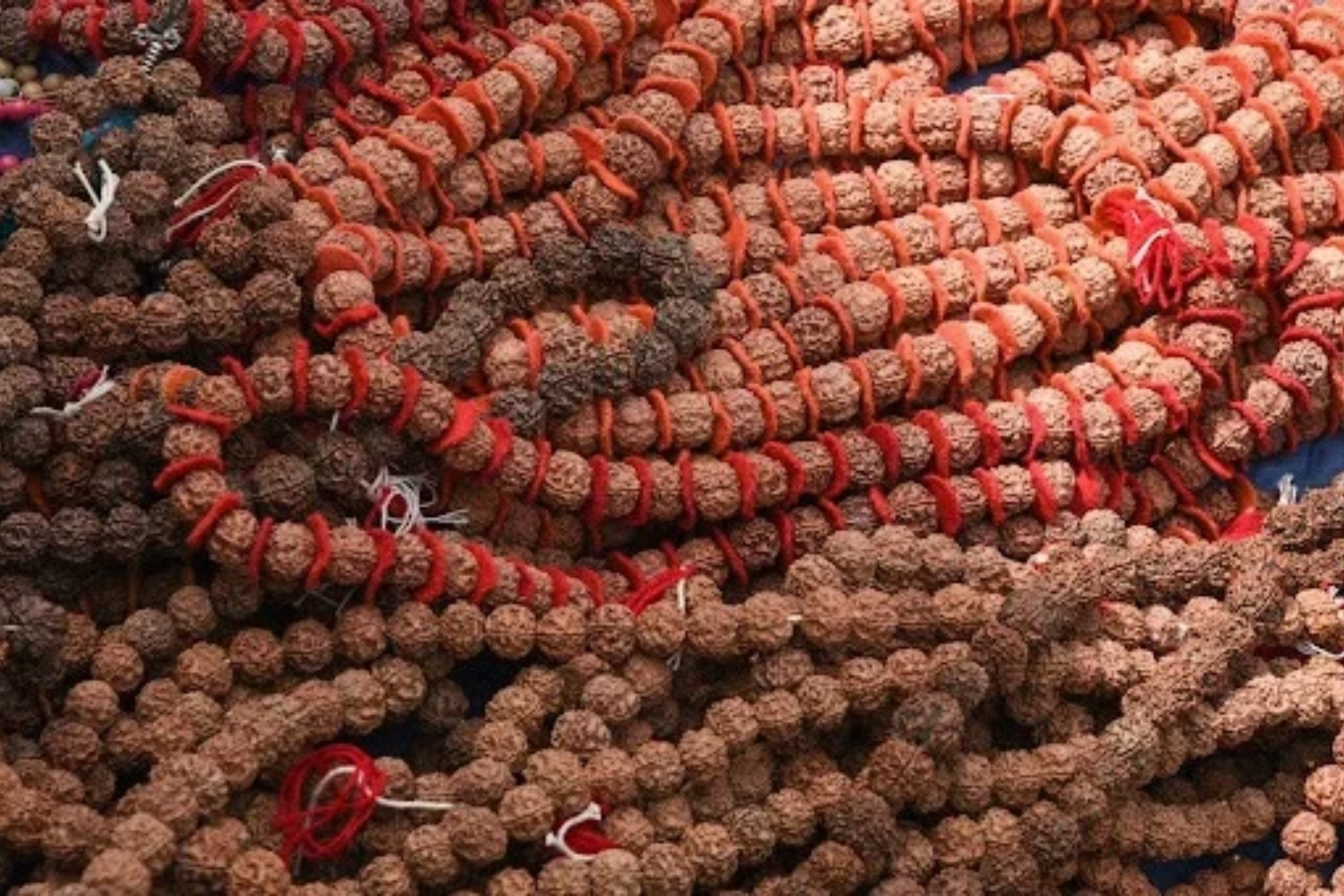
Kali seems to be reading my mind, and her eyes narrow in disapproval. A chill runs up my spine and I refocus my attention on her. She pauses, as if considering what to do with me — take off my head or level me in a pile of dust. I look at her infamous necklace (which is both there, and yet not there). Her tone immediately changes, “Oh, this!” she exclaims like a Texas socialite at a cocktail party, looking down at it admiringly. “This…this is not a necklace of skulls,” she continues. She pulls the necklace over her head and pushes it my way. “See…?” Indeed, the beads are not skulls, but instead seeds that are wrinkled in a way that makes them look like bony faces. “They are rudraksha beads.” I think for a moment that there is no way I can be making this up; it is so far outside of anything I have known or understood. I look at her, confused.
“They are said to be skulls because they are the death of something—the death of your fear of life itself,” she continues. “Here,” she says crisply. “This is how you do it…” and with that she begins to demonstrate an altogether different spiritual practice, one I had never found in any scripture.
As my thoughts and feelings fill the space between us, she plucks each experience out of the air, and as she does, it transforms into a bead; she then threads it onto her necklace. “Like this,” she says, “you’ll see the true nature of all experiences.”
“What is the true nature of experience?” I ask.
“Lifeforce,” she replies firmly.
She pauses. She senses the undoing happening in me. In a flash, I can see the ways my spiritual practices were diminishing me, making me more pleasant to be around, more manageable—especially for those who hurt me and want power over me. My anger must soften, trespasses must be forgiven, and vengeance must dissolve. All in the name of enlightenment.
Weeks earlier, when my mother came to visit us, Isaac asked her, with some measure of pride, “How would you describe Kelly now that she’s been with me for a while?”
She paused. “Subdued,” she responded, flatly.
Kali continues, interrupting my thought, “Your experiences—your feelings, your thoughts, all that you sense—are neither bad, nor good. They simply are. Hence, they all need to be welcomed and embraced.”
She then presses her savage face up against mine. Her eyes ablaze with determination. “Now,” she commands, “open all the doors!”
Her words crack something open, a casing of shame I didn’t know I was wearing, and everything comes in. The stench of stale weed and trash. The grit of the carpet under my palms. My rage at Isaac, at the German girl, at myself. My son’s breath, soft and deep. None of it changes. None of it leaves. It just keeps coming, bead after bead, until there is no space between them, and the whole filthy room is strung on one thread and it is holy. It was always holy.
And the rage doesn’t soften. It burns brighter, hotter, and it feels good. Powerful. Alchemical. Mine.
The walls are still there. I am no longer inside them.
I laugh out loud, waking my baby.
With his cry, just like that, she is gone.
Several weeks later, a letter arrived in the mail. The return address was from Sri HWL Poonja, Lucknow, India. An 85-year-old saint who walked in the Advaita Vedanta lineage of his teacher, the celebrated sage Ramana Maharshi. He was (and still is) my teacher, a guide and mentor. He wrote, “…I have changed your name to Kali. I don’t know why such a name would come to you.” He continued with his usual caustic and ironic wit, “She is such a terrible goddess. But it is your name nonetheless.”
I can’t say that life became amazing after that vision. Kali's teaching heralded the beginning of waking up from a “spiritually correct” trance, unlearning entrenched concepts, and deconstructing a life built around an old story. The subsequent decades were extremely difficult and often confusing. I had no guidance or counsel (Poonja died soon after sending that letter), but I began to recognize aspects of her teaching in the natural world, which kept pulling me toward it.
The event marked the beginning of the end of my marriage. And the beginning of a life and eventual vocation dedicated to identifying and dismantling the truisms that persist inside our most precious spiritual and psychological ideologies.
Until now, I’ve shared this story with only a handful of people close to me. In part, because it is a sacred story, meant only for those who would not diminish it. And in part, because I didn’t want to be shamed. But this morning, as our current world paradigm sits on the brink of annihilation, I knew it was time to share the vision with a larger audience.
My mentor, the Aboriginal Elder of Uluru, Australia, “Uncle” Bob Randall, taught me that when a vision is shared with others, those people are meant to receive it too. So, dear reader, Kali must have wanted to reach out to you.
Kali invites us into a radical way of being—embracing all of life’s experiences. To do it as an embodied practice of feeling all feelings. This grants the ultimate freedom: unconditional fearlessness in the face of anything life presents. This is love at its highest level. This fearlessness is dangerous to the status quo.
The dominant paradigm relies on a population that is well-behaved, using shame to keep us in check. We are warned that if we allow our feelings to be deeply experienced, we’ll walk around Kali-like — a monster — unhinged and toxic. This approach pervades our institutions: our schools, our churches, our communities, our organizations and — most insidiously — our wellness and spirituality domains.
When most people think of healing or spiritual growth, they think of becoming more calm, releasing difficult feelings, ending old patterns, and a greater capacity for understanding — including understanding and forgiving those who hurt them. They think of a quiet mind and a regulated nervous system.
“Don’t buy it,” writes my mentor David Bedrick, visionary teacher, counselor, and author of The Unshaming Way. “Not because calm and regulation don’t matter — they do — but because when this vision is presumed to be the only way healing looks, it breeds disempowerment and shame. And it keeps us from seeing how political this vision actually is.”
I encounter this story everywhere in my work: under anger, there's grief. Under resentment, under the urge for revenge—hurt. Under jealousy—yearning. And when healing comes, the story goes, the fire dies down into something softer, something the culture can tolerate. We tape crystals over our experience, soften our gaze, and become a “better” human.
Sometimes that's true. Sometimes the opposite happens.
I know this because I have experienced this myself, not only in Amsterdam, but countless times after. And I have witnessed it in my work. I’ve watched people arrive at Buffalo Spirit Ranch carrying years of grief, or the low gray hum of depression, and leave with fire in them. They come out sharper and louder, more willing to confront injustice. And they use that fire to transform their lives.
Theo, an engineer with a flat voice and eyes that slide away from mine, comes to the ranch for a few days to, as he puts it, “discover what I’m missing.” His ex-wife has full custody of the kids now. Underneath the flatness, he is furious.
In the forest, I ask him where the anger lives in his body. “I feel like a bear,” he says.
“Great. Be the bear!”
At first, his gestures are subtle: deep breaths, rolling his shoulders. But after a few minutes and some encouragement, he becomes the bear. He crashes through the scrub oak. He growls, swats, snaps branches. He roars.
When he’s spent, I ask, “What does Bear know about being a father whose children were taken?”
Theo straightens, and he looks me squarely in the eyes. “To remain connected to them no matter what and keep fighting to be their father. They need their father.”
Weeks later, I received an email. “I’ve hired a lawyer. They remind me of that bear energy I felt in the forest with you, and I’m energized by the real possibility I’ll be with my kids again.”
Healing doesn't always soften us. Sometimes it wakes us up.
So the belief that hard emotions naturally move toward release and resolution is a mere truism. It sounds right; almost everyone nods along, but it doesn't hold.
It's appealing. It's seductive. The question is why, and for whom.
The dominant paradigm would rather you not wake up the beast inside you. It survives on your being cowed into submission, busily “minding your own business” or “giving grace” to those who are quite literally stealing from you, robbing you blind every day—of your rights, your agency, and your humanity.
This is what Kali knew, and I had been taught to forget: ferocity is not the opposite of love. It is love with its eyes open.
When a vision of psychological and spiritual healing funnels people toward being less fierce, less disturbing, less resistant, less hungry, less annoying—that vision is a form of colonization: the internalization of values that serve those in power at the expense of those who are not. Such tameness is allowing wolves into the paddocks of lambs. “Go on in,” we say as we open the gate, “I’ll just be sitting here meditating on peace.”
We need to be dangerous right now.
To do that, I invite each of you to not just consider Kali’s teachings intellectually, but to somatically experiment with “opening all the doors” to your felt experiences. Each feeling, pleasant or terrible, gets picked up and threaded on. It isn’t fixed or transmuted, just strung.
When you hold each “bead”, take literally two minutes to just be still with it, and be with the feeling as is. Your anger is not a problem to be solved. Your despair doesn't need to pass. Your attachment is not something to let go of. These are all aspects of life force that want to be experienced.
Then see what happens.
If this essay moved something in you, there is more.
Every month, I write on a theme like this one, and for EQUUS Collective members, it comes with an audio version of the essay, an Insight to help you carry it into your own life, and the Gathering, a live conversation where we talk through it together.
If you want to keep going deeper than a single essay can take you, I would love for you to join us.
-Kelly