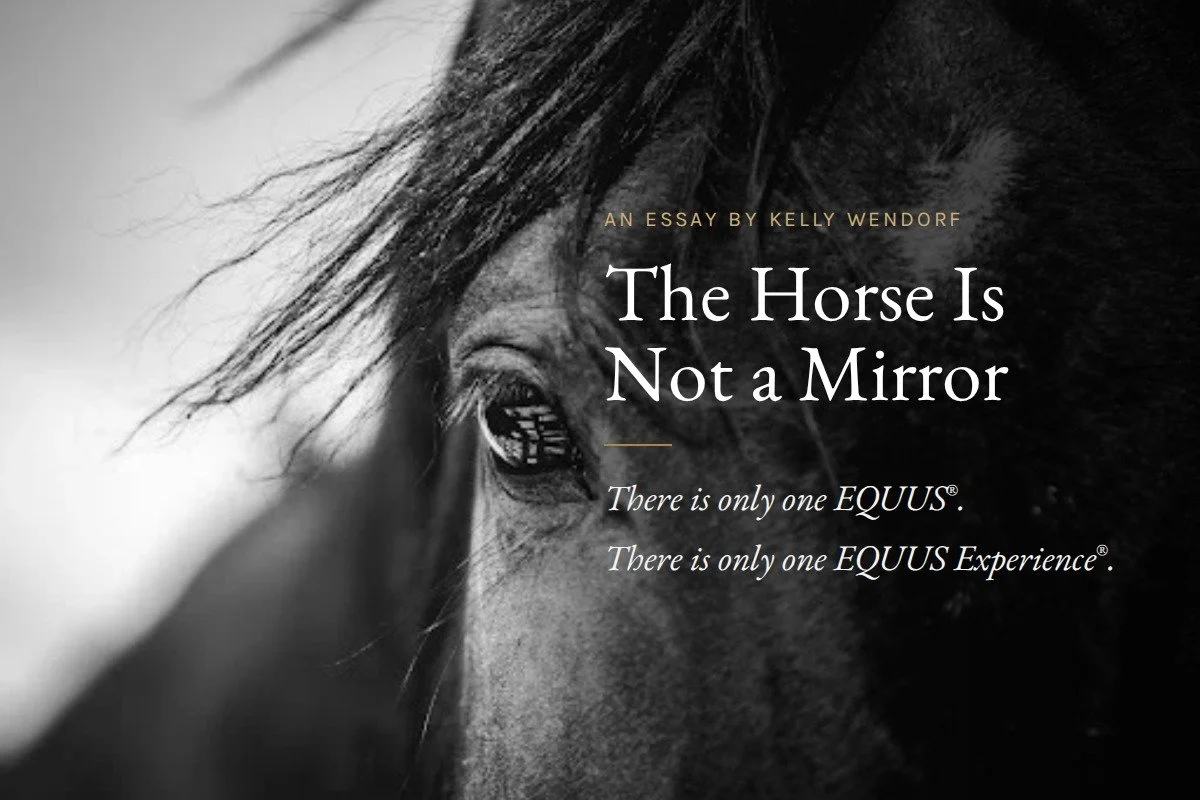
On a breezy Friday afternoon, eight executives file into the arena with seven equines: five horses and two donkeys. The people hang back, not sure what to do with the freedom they’ve been given. “Just be yourself, and see what you discover,” says the facilitator, who then peels away and tucks himself along the fenceline to observe. For a moment, nothing seems to happen. The horses cluster together, exhale, and shift their weight. The donkeys, ears pricked forward, march up to one young woman and surround her, their bodies forming a yin-and-yang symbol around her.
And then something shifts. The largest of the horses, Merlin, a black draft with heavy legs, large dark eyes, a flamboyant mane, and an overwhelming presence, breaks with the herd and singles out a tall man standing apart from the rest. He strides resolutely to the man and stands ominously in front of him, just inches away. David, a senior-level leader at an investment firm, stiffens. He’s not sure if he should break away. Merlin towers over him, still and respectful, albeit a bit intimidating.
But David knows why he came here: to face his greatest fear, losing control. Merlin assists, not by reflecting David back to himself, but as a sentient being making a choice, responding to David’s unspoken yearning. David has the opportunity to meet him there.
After a few minutes, David begins to breathe deeply, in unison with Merlin. “I wasn’t sure how this issue was going to present itself to me in the arena,” David said later. “But my fear of losing control has for years trapped me in survival mode at work, and it has cost me a lot.” Despite his success, David was prone to micromanaging and lashing out at his team when things were stressful. He knew this was his glass ceiling, and in spite of years of coaching, he had yet to change his behaviors.
Merlin could give David something no coaching conversation could: an acute fight-or-flight response that David could work with in real time. Not only was Merlin breathtakingly intimidating by his sheer size, he also presented David with an option: to breathe deeply and remain in the discomfort of the alarm bells going off in his brain.
The power lies beneath the interaction. Through a co-created relational field that both Merlin and David consensually enter, a wisdom emerges that is only possible within shared vulnerability and kinship.
What we inherited
For decades I was taught that power over was a necessary tool, that with an animal this large, safety depended on force. “Don’t let ’em know you’re scared!” I was scolded. “Show ’em who’s boss!” Most of us learn that horses need to be controlled by halter, bridle, and round pen. They are large and unpredictable, we reason, and we need to be the boss to keep ourselves safe. Many leadership training programs run on the same power-over premise, relying on control, hierarchy, and compliance to meet the demand for peak performance amid unpredictable forces, whether emotional, interpersonal, market, or political.
What we call “collaborative” approaches, in leadership and horsemanship alike, are still domination practices dressed up as more humane, and therefore preferred, ways of getting things done. I practiced these too, believing they were kind. But the power dynamics remain the same; they are just more subtle.
This unquestioned power-over paradigm is the water we swim in, too close to see. And it doesn’t stay in the arena. David’s fear of losing control is not his alone. Scale it up and it becomes the logic that treats a team as a machine to be managed, a forest as timber, a river as a resource, a planet as something to be mastered. The grip is the same. Only the size of what’s being held changes.
And at every scale, the cost is the same: we trade resilience for the feeling of control.
If we are going to loosen our fear-based grasp on the proverbial lead rope, our approach in the arena must rest on an entirely different paradigm: the power-with paradigm.
Something essential needs to change
The evolutionary intelligence of nature, a 3.8-billion-year-old living system, offers clues to a new way. In nature, power-with systems (such as decentralized ecosystems, mutual aid networks, and symbiotic relationships) are more resilient than power-over systems (such as rigid hierarchies or a single dominant apex) because they distribute function, remove single points of failure, and rely on cooperation rather than top-down control. Nature shows us how power can be leveraged for thriving.
Within that 3.8-billion-year-old system, one of the oldest and most successful mammals on earth is the horse, who has galloped through countless Adaptive Cycles to evolve and thrive through 56 million years of tectonic shifts, climate spikes, volcanic mega-explosions, and even comets.
What has allowed them to survive for so long? A power-with leadership style that supports a culture of safety, connection, peace, freedom, and joy.
In my book, Flying Lead Change: 56 Million Years of Wisdom for Leading and Living, I recount the neuroscience, regenerative theory, Indigenous wisdom, and nature-informed research behind why horses are alchemical teachers for these times. Horses don’t just facilitate. They transform.
Horses leading the way
But in facilitating Equine Assisted Learning (EAL), we can’t partner with horses using the same old conventional approaches to power and hope to make any substantial change in anyone’s life. It may look innovative and edgy, but it only colludes with the same power-over dynamics that brought people into the arena in the first place. Clients may leave feeling changed, but the horses, and the clients’ own nervous systems, will know the difference.
At EQUUS, we strive to remain ardent students of the horse, unlearning the narratives, beliefs, and practices reinforced through the ages, and instead putting the horse first. It’s not always efficient, or practical, or financially prudent. We find ourselves in the depths of the unknown much of the time, but we know we are onto something powerful and game-changing, not only for our organization and our EQUUS Experience® Certified Facilitators, but for our clients too.
Our EQUUS horses work at liberty, meaning they roam free without halters, lead ropes, or controlling devices of any kind. They choose when and how they work, and when they ask to leave the space, they are given that freedom. Our “training” approaches are nonviolent, noncoercive, and free from punishment-and-reward styles of work, even the gentler kinds. Instead, we play to their gifts, their curiosity, and their sovereignty. As practitioners, our relationship with horses is more totemic than authoritative or parental.
They live together in a herd and have free choice of hay at all times, on land held sacred, honored for its presence and its own intelligence. They work in concert not only with each other, but with all the other beings that surround a session: the birds, a breeze, a barn cat who joins in. Our EQUUS Experience® Certified Facilitators are taught to be profoundly attuned to subtext, energies, communications, dynamics, nervous systems, and all that wants to come into the client’s work at hand. And they are grounded in the practicalities of daily life for a leader, team, or company: strategy, operations, business structures, and balance sheets.
The shift of a horse’s weight from one hoof to another is as significant as the facial gesture of a senior-level executive as he articulates a desired outcome. All of it is working within the tapestry of a living system poised for transformation.
Striving for mutualism
There is a question every honest practitioner of this work should be asked. It isn’t whether the horses help us. It’s what we owe them.
For most of our shared history, horses have been measured by use. Livestock are valued for what they produce, pets for how they please and perform. Either way, humans set the animal’s worth, and when the usefulness ends, the relationship often ends with it. Old horses get sold down the line. Lame ones quietly disappear. The arena empties and refills.
At EQUUS, we begin somewhere else. Our horses are not equipment or tools for a program. They are teachers, carriers of an intelligence refined over 56 million years, and we try to meet them as reverent students do.
What our clients meet isn’t a single animal pulled from its family. It’s a society, with its own relationships and its own ways of deciding. It’s a superorganism that has thrived through countless adaptive cycles over millions of years, with an extraordinary intelligence and a keen awareness for sensing and understanding the humans who walk into its space.
And they can say no. In a session, a horse is free to walk away. When one does, we don’t bring her back. We ask what she is telling us. Often the walking away is the lesson.
I’ll be honest: I am still learning what a truly consensual relationship with a horse looks like. Unlearning dominant narratives and behaviors takes a long time, and it has not come as a single insight. It is a daily practice, and the horses are the ones teaching it, and deciding whether I am living it.
EQUUS and our learning campus, Buffalo Spirit Ranch, are the herd’s forever home. When they grow old, they stay. When their bodies falter, they stay. Artemis, our alpha mare, is nearly 30 now. She’s not ridden, but she still shows up for sessions and has a meaningful, connected existence. She continues to instruct powerful leaders in the nuances of true power-with leadership.
Our facilitators have unlearned power-over too
EQUUS Experience® Certified Facilitators are a unique breed of coach. Whether they are working alongside a herd in an arena or over Zoom with a 1:1 client, they bring the same attuned, presence-based approach. They know how to sense the field, read between the lines, sense a “no” when someone is saying “yes,” articulate non-shaming approaches to change, and, just as importantly, know when, for the sake of change, nothing needs to be said or done.
“I’ve learned that the process is less about knowing the right exercise or asking the perfect question,” says Nora Kenny, newly minted EQUUS Experience® Certified Facilitator (Costa Rica and US mainland). “It’s more about how I show up. The training has helped me become more grounded, present, and able to trust what’s unfolding. That’s what creates space for real transformation.”
The invitation
Each year, I take on a small handful of students (fewer than eight) for a journey of personal transformation and wild wisdom. The EQUUS Experience® Certified Facilitator (EECF) training is a two-year hybrid program that will shape you not only to be masterful alongside an ancient teacher, but to be the very instrument of change so needed in a world that has come to the threshold of immense change.
As a prerequisite, students are already tested coaches and accomplished horsemen and horsewomen. They come to train with EQUUS because they sense something calling to them, and because they resonate with the power-with values we endeavor to uphold. EQUUS helps turn that vision into a vocation.
Back in the arena
Merlin continues breathing with David. His giant ribcage moves in and out, his nostrils flaring with each breath. David’s heart rate slows. Merlin’s eyes half-close in response. After several more minutes, Merlin lets out a long exhale, then turns and walks away.
“The experience was potent and life-changing,” David wrote to us weeks later. “I am more regulated in the face of challenge, and my nervous system has found a micro-moment of pause before I react. In that pause, I remember to breathe, and I respond differently. I thank you, and my team thanks you.”
A horse who is free to walk away will always tell you the truth. That idea sits at the heart of the EQUUS Experience® Certified Facilitator training, and it is the subject of Kelly Wendorf’s essay, The Horse Is Not a Mirror.
In it, Kelly follows a senior leader into the arena with Merlin, a towering black draft horse, and explores what becomes possible when power is shared rather than held. She writes about unlearning the power-over habits so many of us inherited, about why our herd works at liberty without halters or lead ropes, and about what we owe the horses who teach us.
It is also the clearest picture of how our facilitators are trained. The EECF program is a two-year hybrid journey for accomplished coaches, horsewomen, and horsemen, and fewer than eight students are accepted each year. Certification comes from the source: Kelly Wendorf, MCC, MECD, and the EQUUS herd at Buffalo Spirit Ranch.