The Gift of a Burning Mountain
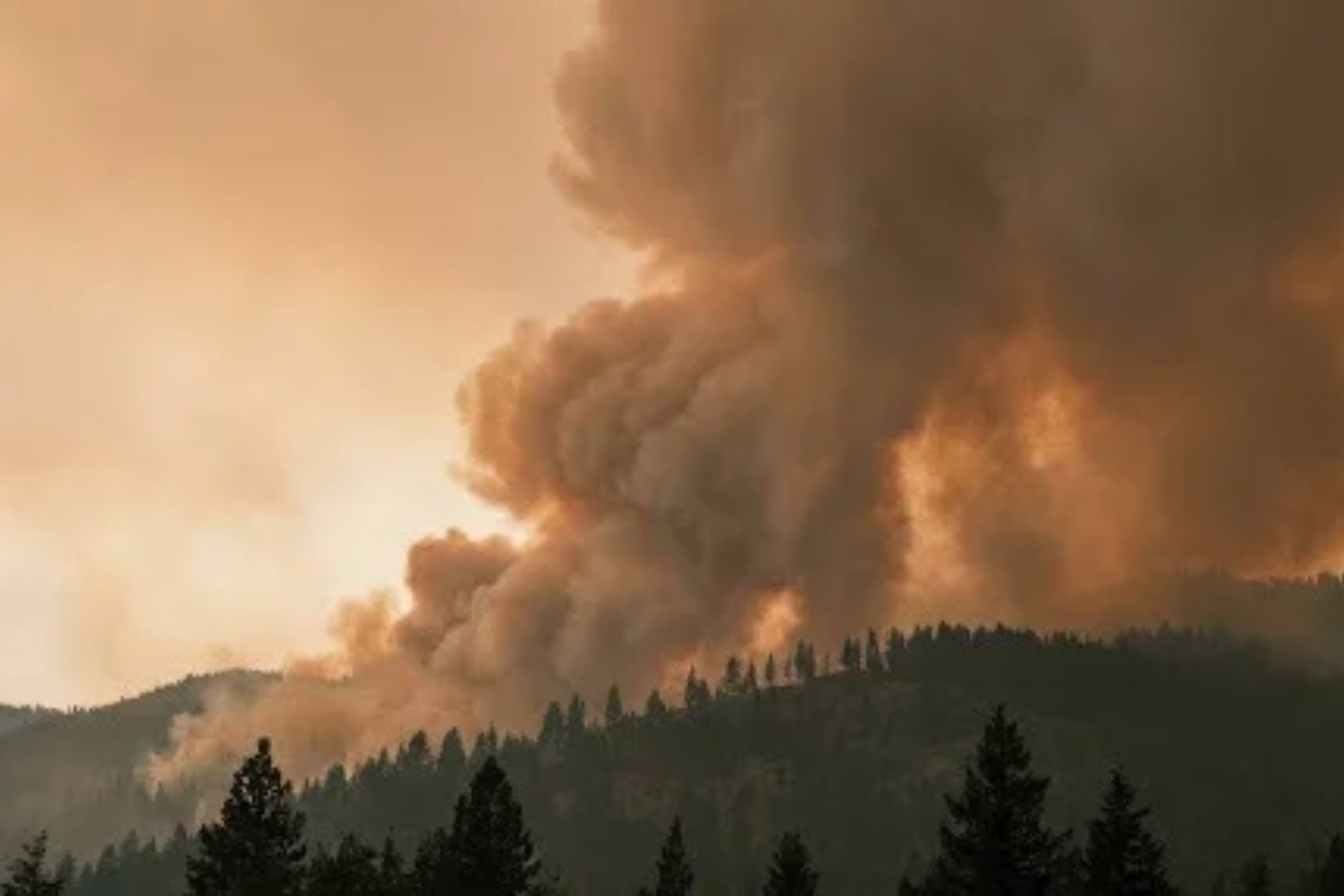
I woke up at dawn, my eyes stinging as if they had been sandpapered open, and looked out the window to see, well, nothing. The smoke eclipsed the trees just 30 feet away. A thick grey veil blanketed the ranch and everything around it. Wrapping my robe around me (no time for boots; flip-flops will have to do), I hastily walked out to the paddocks, dogs in tow—were the horses still breathing? They were, but a conspicuous silence, in contrast to the usual riot of morning animal life—birdsong, donkey brays—unsettled my nervous system.
A strange death-adjacency arises when a fire takes up residence next door. The Frijoles Fire was just 10 miles from my doorstep and had settled in for the ride. Days turned to weeks, and my usual morning routine of coffee and writing was replaced with checking two apps—Watch Duty to track the fire, and Weather to see if I could hang a prayer on a raindrop or two. On sleepless nights, I counted off checklists instead of sheep: cat crates, halters, gas in the truck, air in the horse trailer tires, hay bags… The hummingbirds in my garden became my proverbial canaries in the coal mine. If they returned each day to the smoke and heat, then it was safe to stay.
The elements all have their wild and destructive natures that place us toe-to-toe with death. Water brings floods, air brings tornadoes, and the earth itself can quake. Their living expressions are brief, yet total and cataclysmic. But fire expressed in a forest, unlike the others, stays for a while. A long while, embedding itself into every minute of every day and night. In so doing, a forest fire gives us a chance to become deeply acquainted with its invitation to live alongside death and the insights and questions that arise in the face of it.
Author, journalist and former Buddhist monk (and friend) Alan Clements writes, “There is…a profound difference between knowing that we will die and letting that knowledge come close enough to change the way we touch our lives. Almost everyone knows death is inevitable; remarkably few of us live as though this were true. We postpone difficult conversations because there will supposedly be time later. We preserve resentments as though supplied with an unlimited number of tomorrows. We become preoccupied with status, possession, reputation and the maintenance of an identity that death will eventually dismantle with an indifference that can be terrifying, but also strangely clarifying.”
Amidst the smoke and the haze, I became clear. My priorities were rearranged, my values honed. Wheat was separated from chaff. My mind began to consider the very real possibility of losing everything and what really mattered began to emerge in my heart. Not the truck, not the barn, not even the house with its photographs and art — but this: the huff of a horse's breath against my palm, my children’s voices on the phone at night, the particular gold the light turns before the smoke swallows it. Things I could not load into a trailer. Things that were, it turned out, already safe, because they were already here— the small, unrepeatable choreography of an ordinary day.
When death sits nearby, daily life indeed remains oddly ordinary. We are tethered to all the mundane tasks of running a ranch as if nothing remarkable is happening. Horses and donkeys are fed, paddocks cleaned, flowers watered. But the quality of the tasks transformed into sacred acts. Each moment reveals itself to be a miracle, a gift. This moment, we are safe; this moment, we are alive; this moment, we can take our next breath. I found myself marveling at the smallest things—the soft brown eyebrow hairs on my dog Katy’s face as she greeted me in the morning, the air moving out of the giant nostrils of my horse Merlin as I slipped on a halter, the astonishing near-psychedelic symmetry of a pinecone as I swept the patio. Every moment became an invitation to live passionately into every seemingly mundane choice, to become acutely present to the preciousness of the tiniest detail.
Just a few miles down the road, FEMA set up facilities for over 1,000 firefighters. On a smoky afternoon, I pulled up to a gas station next door to it, and gasped, overcome by the unexpected scene—acres of tents and camping trailers spread out before me on a concrete field. Men and women in bunker gear and helmets holding styrofoam coffee cups, sitting on the ground resting, and embarking and disembarking from fire trucks. All these people dedicating their lives to help the forest and protect our small Northern New Mexican communities—I was overcome with emotion. A young firefighter, bearded with full-sleeve tattoos down both arms, walked by my truck, looking exhausted. Through my overwhelm, I stammered a “thank you,” and our eyes locked. He held the gaze, exhaled, and nodded. The beauty of humanity revealed itself in that moment—a powerful and necessary antidote to the current season of polarization and hatred seething in the veins of America. This is who we truly are, I thought as I drove away. That night I read a post about one of their own dying while in combat with the fire, a Native man from Arizona who came to help out.
And so as the fires raged and spread, as winds kicked up and news of nearby communities evacuating filled my feeds and text threads, life at the ranch became increasingly sublime. As death loomed, my heart expanded, and new life blossomed. One particularly intense day, I walked past the arena, and I paused to see Michael, our Ranch Manager, driving the UTV with a new ranch team member, teaching her how to drag lines in the sand with the precision of a monk raking hōkime in the dry landscape of a Zen monastery.
I’m grateful I did not—like so many in these times of catastrophic natural events—lose everything. But I’m profoundly grateful for my new neighbor Frijoles, who remains today, asking me to consider the possibility, asking me to embrace death’s invitation to live more fully, and value what’s truly precious.